
Selecting the correct FRP Absorption Tower is an important decision for chemical plants, electroplating facilities, fertilizer factories, and other industries requiring reliable waste gas treatment. Different industrial processes generate different types of exhaust gases, and the tower design must match actual operating conditions to achieve stable purification performance.
A suitable Waste Gas Treatment Tower is not selected only according to equipment size. Parameters such as gas flow rate, pollutant concentration, operating temperature, pressure drop, packing design, and spray system configuration all influence absorption efficiency and long-term operation.
Many industrial users focus on the tower price when choosing suppliers, but an improperly selected system may lead to low removal efficiency, higher chemical consumption, increased maintenance requirements, or unstable operation. Professional FRP Scrubber Selection requires a complete evaluation of process conditions and environmental requirements.
This guide explains the key factors that should be considered when selecting an FRP Absorption Tower for different industrial applications.
Every industrial application has unique exhaust characteristics. Before selecting an FRP Absorption Tower, engineers must first understand the composition and operating conditions of the gas stream.
Chemical plants may produce acidic gases such as HCl, SO₂, HF, and chlorine, while electroplating industries often generate acid mist containing hydrochloric acid, sulfuric acid, or nitric acid vapors. Fertilizer and chemical processing facilities may require treatment systems for ammonia and other alkaline gases.
The absorption tower must be designed according to the actual gas conditions rather than using a standard configuration. The correct combination of tower size, packing structure, absorbent solution, and spray system determines whether the system can maintain stable treatment efficiency.
Gas flow rate is one of the most important factors in FRP Absorption Tower Selection. It directly determines the required tower diameter, gas velocity, residence time, and internal contact area.
If the tower size is too small, excessive gas velocity may reduce gas-liquid contact time and decrease absorption efficiency. It can also increase pressure drop and place additional load on exhaust fans.
On the other hand, an oversized tower increases equipment investment and operating costs without providing significant performance improvement. Therefore, accurate calculation of gas flow rate is essential for selecting an economical and efficient Waste Gas Treatment Tower.
During design, engineers usually consider not only normal operating conditions but also possible production fluctuations. A properly designed system should maintain stable performance even when exhaust volume changes during industrial operation.
The concentration of pollutants in the exhaust gas directly affects the selection of the absorption process and equipment configuration.
Low-concentration acid mist treatment may only require a single-stage absorption tower with a suitable packing structure. However, high-concentration gases may require multiple absorption stages, stronger absorbent circulation, or additional treatment systems.
For example, a chemical plant producing high levels of HCl gas requires a different design compared with a ventilation system handling dilute acid vapor. The material selection, spray liquid concentration, and packing height must be adjusted according to pollutant concentration.
When performing FRP Scrubber Selection, engineers should evaluate both current gas concentration and future production changes. This helps avoid insufficient treatment capacity when production expands.
Temperature is another critical factor affecting the performance and service life of an FRP Absorption Tower.
Although FRP materials provide excellent corrosion resistance, different resin systems have different temperature resistance capabilities. Higher operating temperatures may require special resin selection, thicker laminate structures, or additional cooling measures.
For example, applications involving hot chemical exhaust gases may require heat-resistant FRP materials combined with optimized tower design. If temperature conditions are ignored during equipment selection, long-term mechanical performance may be affected.
Therefore, temperature conditions should always be evaluated together with gas composition and chemical properties when selecting a Waste Gas Treatment Tower.
Pressure drop is an important parameter that affects both absorption performance and operating costs.
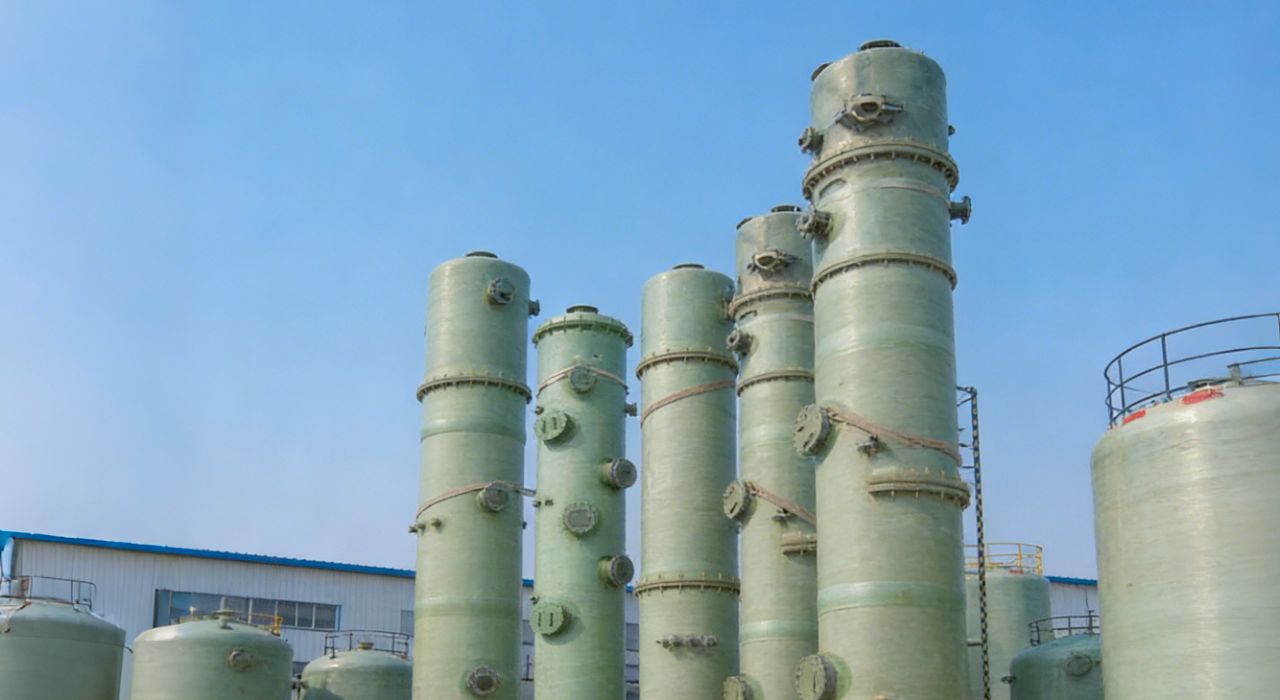
Inside an FRP Absorption Tower, gas must pass through packing materials and internal components. While higher packing surface area can improve gas-liquid contact efficiency, excessive resistance may increase pressure drop and require more powerful fans.
A well-designed tower achieves a balance between absorption efficiency and energy consumption. Packing type, packing height, gas velocity, and liquid circulation rate all influence pressure drop.
During FRP Absorption Tower Selection, engineers should consider the relationship between removal efficiency and operating cost. A tower with extremely low pressure drop may not provide sufficient gas-liquid contact, while excessive pressure drop may increase energy expenses.
Packing height plays an important role in determining absorption efficiency. The packing section provides the main contact area where pollutants transfer from gas into liquid.
A higher packing height generally provides more contact area and longer residence time, improving removal efficiency. However, excessive packing height may increase pressure drop, equipment height, and manufacturing costs.
Different applications require different packing designs. Industries with strict emission requirements may require higher packing sections, while applications with lower pollutant loads may use shorter packing configurations.
The selection of packing height should be based on gas properties, required removal efficiency, packing type, and operating conditions.
A professional FRP Scrubber Selection process evaluates these factors together instead of simply increasing packing height to improve performance.
The spray system is one of the most important internal components of an FRP Absorption Tower. Its purpose is to distribute absorbent liquid evenly across the packing section.
Uniform liquid distribution ensures that the packing surface remains fully wetted and maximizes gas-liquid contact efficiency. Poor spray coverage can create dry areas inside the tower, reducing pollutant removal performance.
The selection of spray nozzles depends on liquid flow rate, chemical properties, operating pressure, and tower diameter. For large industrial towers, multiple spray layers may be required to achieve better distribution.
A properly designed spray system also helps reduce chemical consumption because it improves the utilization efficiency of the absorbent solution.
Different industries require different absorption tower configurations.
Chemical plants often handle highly corrosive gases and require excellent FRP corrosion resistance, optimized packing design, and reliable chemical circulation systems.
Electroplating industries typically generate acid mist with continuous operation requirements. Their scrubber systems must provide stable performance under humid and corrosive workshop conditions.
Fertilizer and chemical processing industries may require customized absorption solutions for ammonia and mixed gas streams. In these applications, absorbent selection and multi-stage treatment may become important factors.
Metal surface treatment industries often deal with hydrochloric acid and sulfuric acid fumes. These applications require strong corrosion resistance and effective mist removal capability.
Therefore, the best FRP Absorption Tower is not a universal standard product but a customized solution designed according to specific industrial requirements.
Choosing the right FRP Absorption Tower requires a detailed evaluation of operating conditions, including gas flow rate, gas concentration, temperature, pressure drop, packing height, and spray system design.
A properly selected Waste Gas Treatment Tower can provide stable pollutant removal, lower operating costs, and longer service life. On the other hand, incorrect selection may result in poor absorption efficiency and unnecessary maintenance problems.
For chemical plants and industrial facilities, working with an experienced FRP Absorption Tower Manufacturer ensures that the equipment design matches actual production conditions.
Professional FRP Scrubber Selection is not only about choosing a tower size. It is about creating a complete waste gas treatment solution that combines material technology, process engineering, and reliable long-term operation.