
An FRP Absorption Tower is a core gas treatment system widely used in modern industrial pollution control projects, especially in environments where corrosive exhaust gases must be continuously neutralized before discharge. Compared with traditional metal scrubbers, FRP (fiberglass reinforced plastic) towers are designed for long-term exposure to acidic gases, alkaline vapors, chloride-rich air streams, and moisture-heavy operating conditions that would normally accelerate rapid corrosion in steel structures. This fundamental difference makes FRP systems not just an alternative material choice, but a completely different engineering approach to gas treatment system design.
In real industrial applications such as chemical production, wastewater treatment, fertilizer manufacturing, and metallurgical exhaust purification, the tower is not operating under stable laboratory conditions but under fluctuating flow rates, variable gas composition, and long-term chemical exposure. Because of this, modern FRP Absorption Tower Design Standards must integrate structural safety, chemical resistance, hydraulic stability, and lifecycle durability into a unified engineering framework rather than treating them as independent design parameters. The performance of the system is therefore determined not only by initial design accuracy but also by long-term behavior under continuous operation.
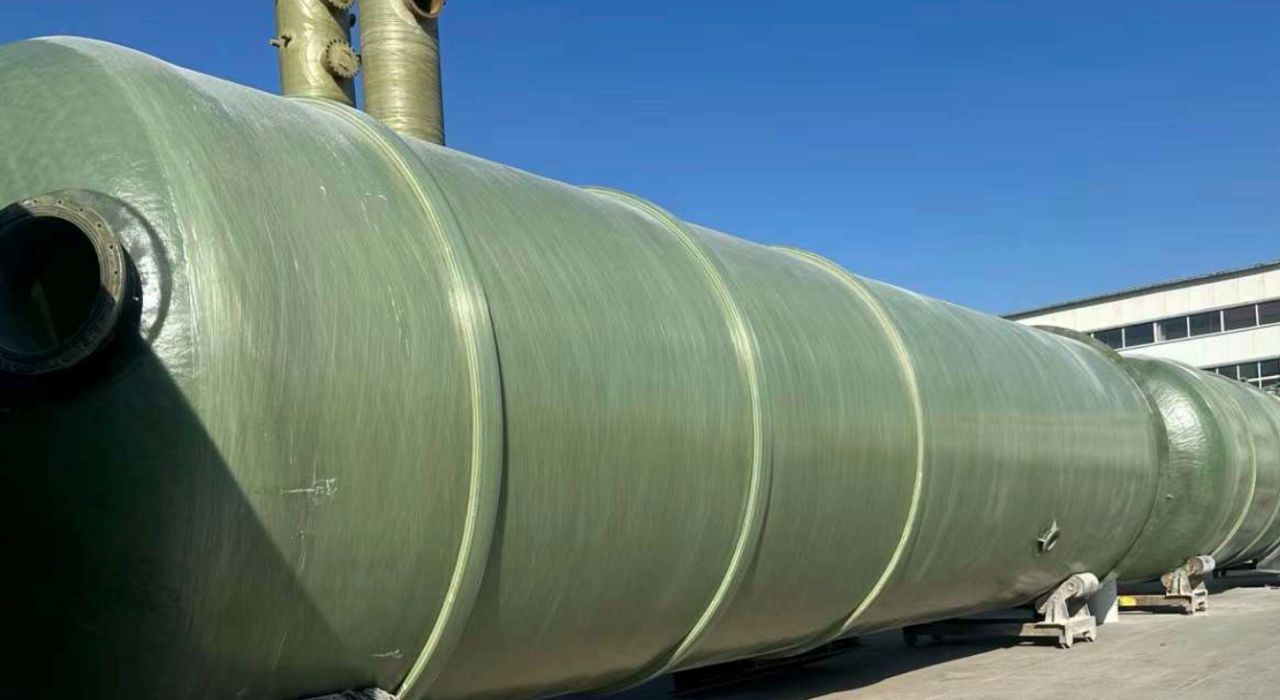
The structural design of an FRP Absorption Tower is fundamentally based on composite material mechanics rather than traditional isotropic metal assumptions. Unlike steel, which exhibits ductile deformation before failure, FRP materials behave in a linear-elastic manner until fracture occurs, meaning there is no visible yielding stage to warn of structural overload. This characteristic forces engineers to rely heavily on conservative safety margins and multi-layer stress distribution analysis during design.
The tower must simultaneously withstand internal gas pressure fluctuations, external wind loads, potential seismic forces, and long-term chemical degradation effects. In addition, thermal cycling caused by exothermic absorption reactions introduces repeated expansion and contraction stress into the FRP laminate structure. These combined load conditions create a complex multi-physics environment where mechanical performance cannot be evaluated using single-factor design methods. Instead, the structure must be optimized as an integrated system where stress distribution, fiber orientation, and resin selection work together to maintain long-term stability.
Safety factor selection in FRP Absorption Tower Design Standards is significantly more complex than in traditional steel equipment because FRP materials do not exhibit plastic deformation behavior. Once stress exceeds the allowable limit, failure occurs rapidly without warning, which makes design conservatism essential in industrial applications. For this reason, safety factors are not only applied to ultimate strength but also to long-term creep resistance and environmental degradation behavior.
In engineering practice, multiple load conditions are combined during safety analysis, including internal gas pressure, wind load on tall structures, vibration from industrial equipment, and localized stress concentration at nozzles and support points. Each of these loads interacts differently with composite laminates, meaning that stress cannot be redistributed in the same way as metallic structures. This requires localized reinforcement design, especially in transition zones where geometry changes occur.
Another important consideration is time-dependent performance degradation. Under continuous exposure to moisture, chemicals, and mechanical load, FRP materials may experience creep deformation and gradual stiffness reduction. Therefore, safety factors must also account for long-term performance decay rather than only initial mechanical strength, ensuring that the tower maintains structural integrity throughout its intended service life.
Chemical resistance is one of the defining advantages of an FRP Absorption Tower, but it is also one of the most complex design parameters because it depends entirely on resin chemistry, fiber structure, and environmental exposure conditions. Unlike metals, which corrode electrochemically, FRP materials degrade through resin matrix breakdown, fiber exposure, and interfacial weakening between fiber and resin layers.
The selection of resin systems plays a decisive role in chemical resistance performance. Vinyl ester resins are widely used in acid gas environments due to their strong resistance to hydrochloric acid, sulfur dioxide, and oxidizing agents. Epoxy systems provide superior mechanical strength but require careful evaluation in highly corrosive environments. Polyester resins, while cost-effective, are generally limited to less aggressive chemical conditions.
In real operation, chemical attack is not uniform but progressive and localized. Small defects in resin structure can gradually expand under continuous exposure, leading to micro-cracking and eventual fiber exposure. Once fibers are exposed, mechanical performance begins to degrade more rapidly. This makes initial material selection and laminate design critical factors in determining long-term chemical durability of the system.
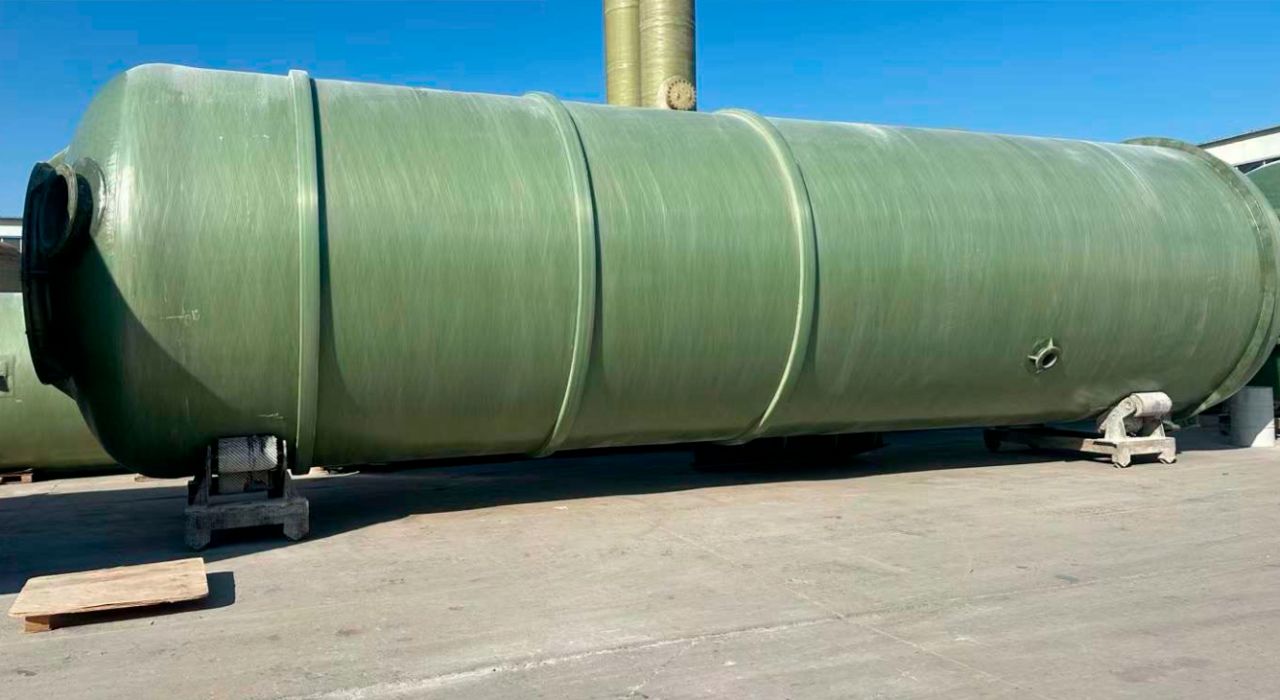
The structural system of an FRP Absorption Tower is composed of multiple interconnected layers, each serving a specific mechanical or chemical function. The outer shell is typically constructed using multi-directional FRP laminates designed to resist hoop stress, axial load, and environmental corrosion simultaneously. Fiber orientation is carefully controlled to ensure that circumferential and longitudinal stresses are distributed evenly across the structure.
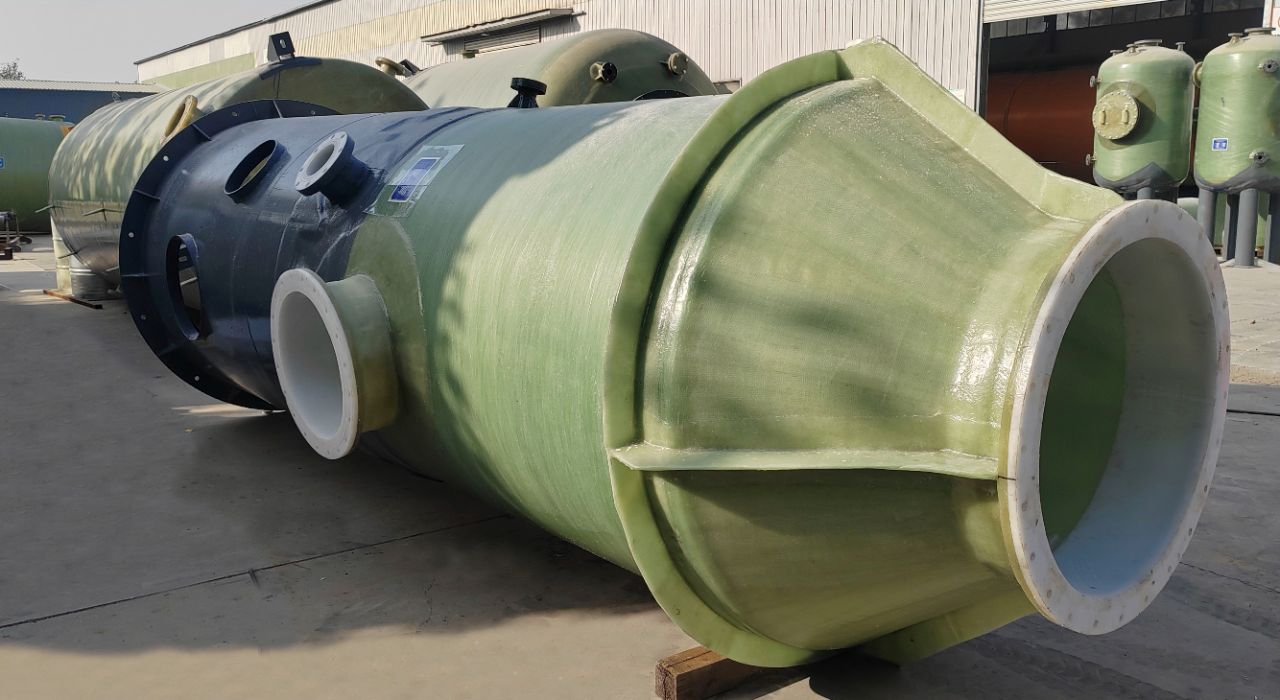
Nozzle regions represent one of the highest risk areas in tower design because they introduce geometric discontinuities that concentrate stress. To compensate for this, designers typically apply localized reinforcement layers, multi-directional fiber winding techniques, and gradual thickness transitions to reduce stress concentration effects. Failure in these regions can lead to system shutdown, making them critical points in structural safety design.
The support structure must also be carefully engineered to handle both static load and thermal expansion effects. Because FRP has a different thermal expansion coefficient compared to concrete or steel foundations, improper support design can introduce additional stress at the base connection. This is particularly important in tall towers where wind load interaction further increases structural demand.
Internal components of an FRP Absorption Tower directly determine its gas treatment efficiency, and their design is governed by mass transfer theory combined with fluid dynamics behavior. Packing systems are used to maximize gas–liquid contact surface area, but their performance depends on maintaining a balance between pressure drop and reaction efficiency.
Structured packing is typically used in high-efficiency systems where stable gas composition and controlled operating conditions are present. It provides predictable flow distribution and high mass transfer rates but is more sensitive to fouling. Random packing, on the other hand, is more suitable for industrial environments with particulate matter because it is less prone to blockage, although it generally offers lower efficiency compared to structured designs.
Liquid distribution systems are equally important because even small deviations in spray uniformity can lead to channeling effects inside the packing bed. When gas bypasses active wetting zones, the effective reaction area decreases significantly, reducing overall system efficiency without any visible mechanical damage to the structure.
Unlike steel structures, FRP systems do not exhibit yielding behavior before failure, which makes understanding failure mechanisms essential in design standards. The primary failure modes include fiber breakage, resin cracking, and delamination between composite layers. These failure modes are often progressive rather than instantaneous, but once initiated, they tend to propagate rapidly under continuous load conditions.
Creep behavior is another important factor in long-term mechanical performance. Under sustained stress and elevated humidity or temperature, FRP materials may gradually deform, which affects dimensional stability and stress distribution. This is particularly relevant in tall absorption towers where continuous load is applied over long operational cycles.
Fatigue behavior under cyclic loading conditions must also be considered, especially in industrial environments where gas flow rates fluctuate. Repeated stress cycles can gradually weaken fiber-resin interfaces, reducing structural stiffness over time and requiring conservative design margins.
Different industries impose different operational requirements on FRP Absorption Tower Design Standards, depending on gas composition, temperature conditions, and emission control requirements. In chemical production systems, towers must handle highly corrosive gases under continuous operation, requiring high chemical resistance and stable hydraulic performance.
In environmental engineering applications, the focus shifts toward odor control and low-to-medium concentration gas treatment, where operational stability and low maintenance requirements are more important than extreme chemical resistance. Metallurgical systems, on the other hand, require high-temperature gas handling capability combined with dust resistance and structural durability under harsh conditions.
Semiconductor and specialty chemical industries demand extremely high purity gas treatment systems where contamination control is critical. In such cases, material purity, internal cleanliness, and long-term stability become more important than mechanical strength alone.
The FRP Absorption Tower Design Standards represent a highly integrated engineering framework that combines structural mechanics, chemical resistance theory, and industrial process engineering into a unified system. Unlike traditional equipment design, FRP tower engineering requires long-term performance prediction rather than only initial strength verification.
The final performance of the system is not determined by a single factor but by the interaction between material selection, hydraulic design, structural reinforcement, and operational stability. In modern industrial environments, successful design is defined by how well the system maintains performance under continuous chemical exposure and variable operating conditions.
When properly engineered, an FRP Absorption Tower provides stable gas treatment performance, long service life, and predictable maintenance cycles, making it a critical component in modern industrial emission control systems.