

When you look at a potassium sulfate (K₂SO₄) production plant, it’s easy to focus on big equipment like furnaces or crystallizers. But in reality, what really determines your product quality, cost, and plant stability comes down to two things:
Raw materials + reaction conditions
If either one is slightly off, the whole production line becomes unstable—yield drops, energy cost rises, and product quality suffers.
In this guide, I’ll break down both sides in a practical, industrial way based on real production logic used in Mannheim process potassium sulfate plants and other SOP production systems.
Industrial potassium sulfate is mainly produced using three categories of raw materials depending on the process:
Potassium chloride is the most important feedstock in most industrial plants.
High potassium content
Stable global supply (from potash mines)
Relatively low cost compared to SOP product value
KCl purity: ≥ 95–98%
Moisture: < 0.5%
Particle size: fine or granular depending on reactor design
It provides the potassium (K⁺) needed to form potassium sulfate.
In simple terms: no high-quality KCl = no high-quality SOP production
Sulfuric acid drives the chemical transformation in the Mannheim process.
Provides sulfate (SO₄²⁻)
Acts as reaction driver
Enables formation of HCl by-product
Concentration: 92–98%
Low impurity level (iron, heavy metals must be controlled)
Stable flow and temperature
Impurities in sulfuric acid can:
Corrode equipment faster
Affect crystal formation
Reduce product purity
Depending on the production route, plants may also use:
Used in double decomposition process:
2KCl+Na2SO4→K2SO4+2NaCl2KCl + Na_2SO_4 \rightarrow K_2SO_4 + 2NaCl2KCl+Na2SO4→K2SO4+2NaCl
Used in natural mineral processing routes.
Langbeinite (K₂SO₄·2MgSO₄)
Kainite deposits
In industrial production, raw materials are not just “inputs”—they define:
Reaction efficiency
Energy consumption
Equipment lifespan
Final product grade
Purity consistency
Moisture content
Particle size distribution
Concentration stability
Impurity control
Temperature consistency during storage and feeding
Now let’s move to the most critical part: reaction conditions.
In industrial systems like the Mannheim process, reaction conditions are extremely sensitive.
For Mannheim furnace operation:
Typical range: 500°C – 600°C
Optimal range: around 520–580°C
Too low → incomplete reaction
Too high → energy waste + equipment damage
Unstable → product quality fluctuation
Temperature is basically the “control knob” of the entire plant.
The reaction must follow a precise chemical balance:
2KCl+H2SO4→K2SO4+2HCl2KCl + H_2SO_4 \rightarrow K_2SO_4 + 2HCl2KCl+H2SO4→K2SO4+2HCl
In practice, engineers slightly adjust ratios:
Excess acid → ensures full conversion
Excess KCl → reduces acid waste but may reduce efficiency
The goal is maximum conversion + stable output, not just textbook stoichiometry.
Most potassium sulfate plants operate under:
Slight negative pressure (vacuum-assisted system)
Prevents HCl gas leakage
Improves safety
Enhances gas collection efficiency
In continuous industrial furnaces:
Residence time: typically 1–3 hours (depends on design)
Incomplete conversion
Lower yield
Energy waste
Reduced throughput
Good mixing between:
KCl particles
Sulfuric acid
is essential.
Poor mixing leads to:
Local overheating
Uneven reaction
Lower product quality
This is why furnace design (not just chemistry) is critical.
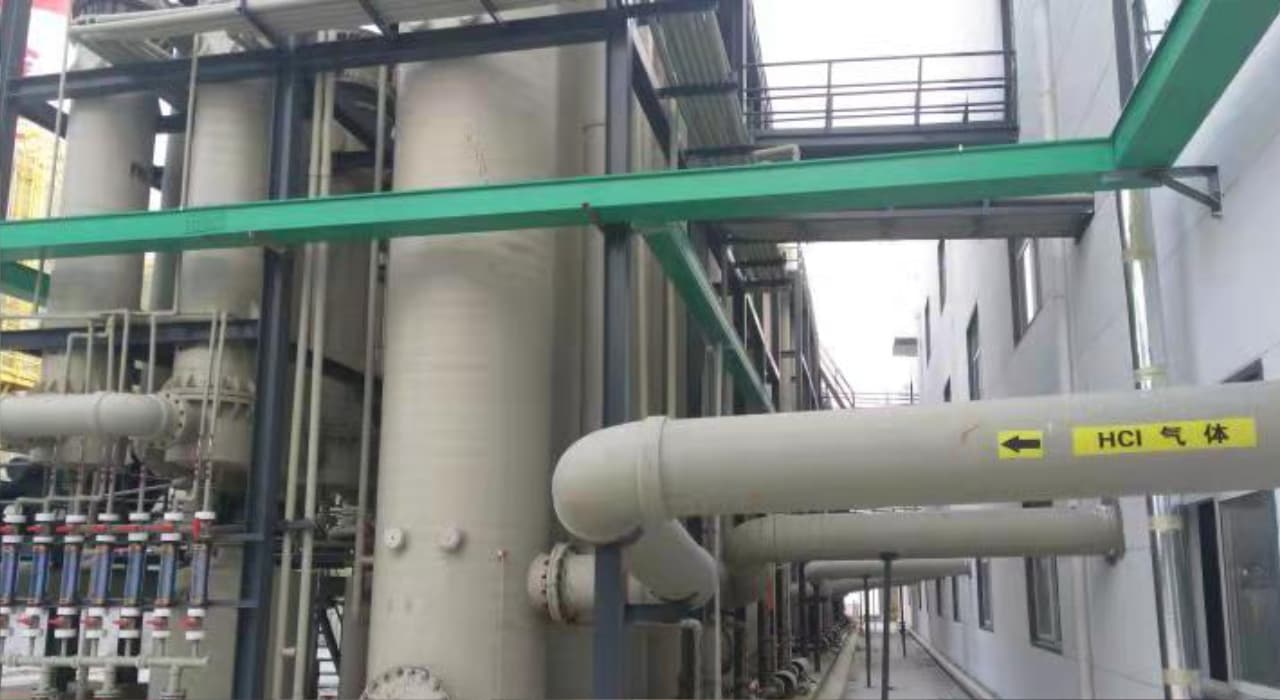
One of the most important by-products is hydrogen chloride (HCl).
KCl+H2SO4→K2SO4+HClKCl + H_2SO_4 \rightarrow K_2SO_4 + HClKCl+H2SO4→K2SO4+HCl
Highly corrosive gas
Must be captured immediately
Requires cooling + absorption system
Temperature control to prevent corrosion spikes
Continuous suction system
Absorption tower efficiency ≥ 95% (typical industrial requirement)
After reaction, potassium sulfate must crystallize properly.
Slow cooling → large, uniform crystals
Fast cooling → fine powder, lower market value
Controls how much K₂SO₄ stays dissolved
Affects yield efficiency
Impurities can cause:
Sticky crystals
Poor drying performance
Color issues
After crystallization:
Moisture must be reduced to < 0.5–1%
Temperature: 120–250°C (depends on dryer type)
Airflow: controlled and uniform
Residence time: optimized to avoid overheating
Modern potassium sulfate plants must control:
HCl absorption efficiency
Acid mist control
Fine K₂SO₄ particles must be captured
Bag filters or cyclones used
Neutralization systems
Recycling loops
In real industrial plants, you cannot separate raw materials and reaction conditions.
They interact like this:
High-quality KCl → stable reaction → better yield
Poor acid quality → corrosion + unstable output
Incorrect temperature → incomplete conversion
Poor mixing → uneven product quality
Everything is interconnected.
Experienced plant operators improve performance through:
Drying KCl
Filtering sulfuric acid
Reduce fuel cost
Stabilize furnace temperature
Real-time feed adjustment
Temperature feedback loops
Convert HCl into hydrochloric acid
Improve overall profitability
The potassium sulfate production process is highly dependent on two core factors:
KCl quality
Sulfuric acid concentration
Impurity control
High temperature (500–600°C)
Precise stoichiometric control
Stable pressure and mixing
Controlled crystallization and drying
In industrial practice, success is not just about chemistry—it’s about process control, engineering design, and system integration.
If these conditions are well managed, a potassium sulfate plant can achieve:
High yield
Stable operation
Strong product competitiveness
Long-term profitability