

If you look at global potassium sulfate (K₂SO₄) production today, one method still dominates industrial-scale manufacturing: the Mannheim process.
It is not the newest technology, and it is not the simplest—but it remains one of the most reliable, scalable, and economically proven systems used in modern fertilizer plants.
In industrial practice, the Mannheim process is not just a chemical reaction.
It is a complete integrated production system combining reaction, heat engineering, gas recovery, and material handling.
This article explains the process from an engineering and industrial perspective, including reaction principles, equipment systems, design parameters, advantages, limitations, and real-world applications.
The Mannheim process is a high-temperature thermal-acid reaction method used to produce potassium sulfate from:
Potassium chloride (KCl)
Sulfuric acid (H₂SO₄)
It is carried out in a specially designed Mannheim furnace, capable of handling:
High temperature conditions
Strong acid corrosion
Continuous industrial operation
In simple engineering terms:
It converts low-cost potassium salt into high-value chloride-free fertilizer through controlled thermal chemical reaction.
The Mannheim process is currently the most widely utilized industrial method for the production of potassium sulfate (K₂SO₄).
For further details regarding this complete system, please refer to our Comprehensive Guide to Potassium Sulfate Production Plants: Process, Design, Equipment, and Costs.
The process is based on a two-step reaction mechanism:
2KCl+H2SO4→K2SO4+2HCl2KCl + H_2SO_4 \rightarrow K_2SO_4 + 2HCl2KCl+H2SO4→K2SO4+2HCl
KCl+H2SO4→KHSO4+HClKCl + H_2SO_4 \rightarrow KHSO_4 + HClKCl+H2SO4→KHSO4+HCl
KCl+KHSO4→K2SO4+HClKCl + KHSO_4 \rightarrow K_2SO_4 + HClKCl+KHSO4→K2SO4+HCl
The Mannheim reaction has three key characteristics:
Endothermic reaction → requires continuous heat input
Temperature-sensitive → strongly dependent on 500–600°C control
By-product formation → HCl gas is continuously generated
This makes the process both a fertilizer production system and a chemical recovery system
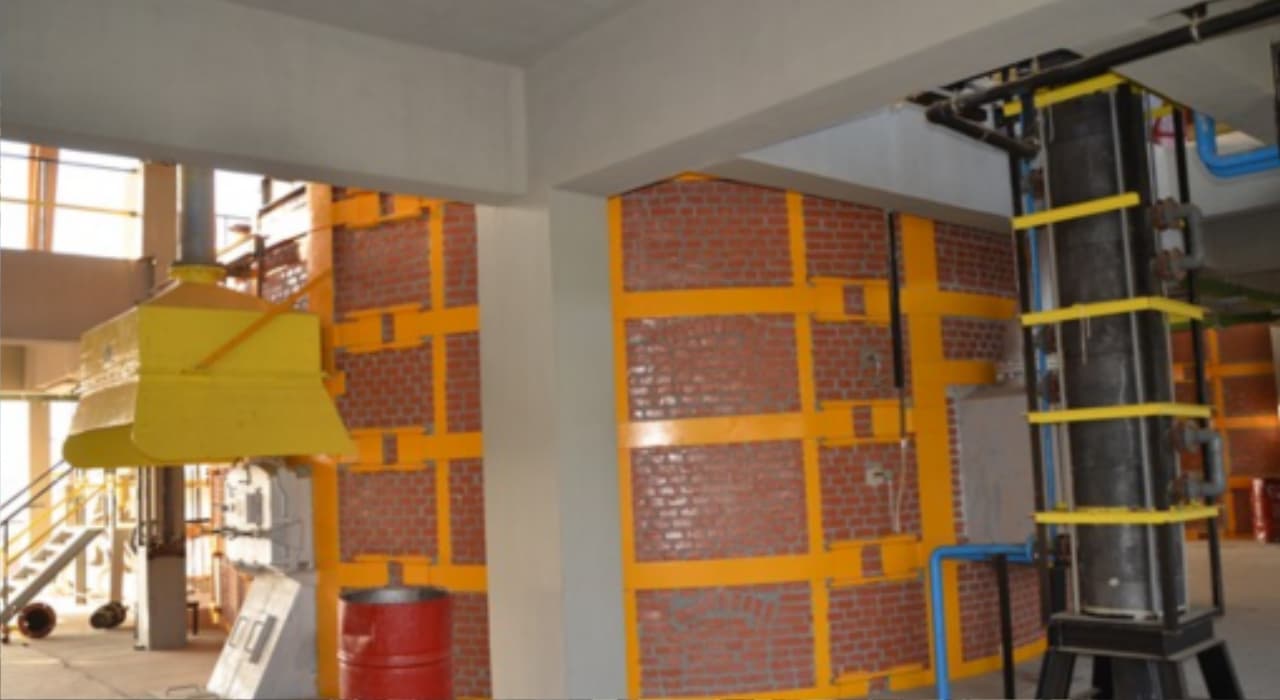
The Mannheim furnace is the heart of the entire plant.
500∼600∘C500 \sim 600^\circ C500∼600∘C
Temperature: 500–600°C
Operation: continuous
Pressure: slightly negative
Feed control: strict stoichiometric ratio
Acid-resistant reaction chamber
High-efficiency heating system
Controlled feeding system
Gas extraction system
Solid discharge system
Inside the furnace:
Reaction occurs in molten phase
Intermediate (KHSO₄) forms first
Final K₂SO₄ crystallizes during cooling
HCl gas is continuously released
Furnace design directly determines plant capacity and energy efficiency
One of the most critical components of the Mannheim process is gas utilization.
Without treatment, HCl gas is:
Highly corrosive
Environmentally non-compliant
Unsafe for industrial operation
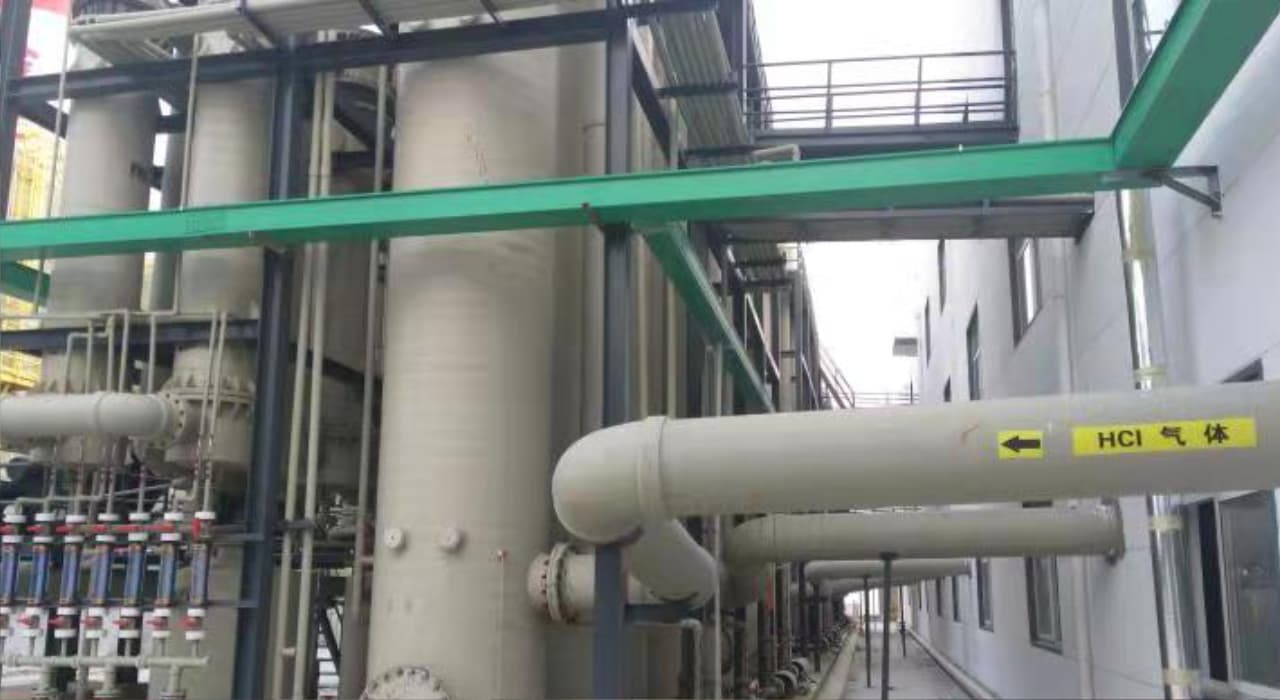
HCl gas is captured and processed into hydrochloric acid:
HCl gas → absorption tower → HCl solution
Absorption tower
Cooling system
Scrubber unit
Acid storage tanks
This is not waste treatment.
In many industrial plants, HCl recovery contributes directly to plant revenue
This improves:
Overall ROI
Operating margin
Chemical integration opportunities
A complete plant system follows:
Raw material preparation (KCl drying, H₂SO₄ storage)
Precise feeding system
High-temperature reaction in Mannheim furnace
HCl gas capture and absorption
Solid product discharge
Cooling and crystallization
Drying and purification
Screening and packaging
The system operates as a continuous closed-loop industrial chain
Core reaction unit
High-temperature corrosion resistance
Continuous operation design
Controls reaction ratio
Ensures stability of conversion rate
Converts HCl into hydrochloric acid
Directly impacts compliance + profitability
Controls particle formation
Affects final fertilizer grade
Rotary or fluidized bed dryer
Ensures storage stability
Reduces emissions
Protects equipment and environment
Widely used globally
Proven engineering design
50–52% K₂O equivalent
Suitable for premium fertilizer markets
Stable output
Ideal for EPC projects
Improves economic efficiency
Supports chemical industry integration
Requires continuous heating at 500–600°C
Fuel cost is significant
Acid + HCl gas causes equipment wear
Requires high-cost materials
Gas treatment must be highly efficient
Strict emission standards in many countries
KCl purity directly affects reaction efficiency
Impurities reduce yield
SOP (Sulfate of Potash) production
High-value agriculture fertilizers
Hydrochloric acid production
Chlorine chemical chain support
Premium agriculture markets
Specialty crop production
Despite alternative technologies, Mannheim remains dominant because:
✔ Proven large-scale industrial performance
✔ Stable product quality
✔ Valuable HCl by-product recovery
✔ EPC project compatibility
In most real fertilizer investments, Mannheim is still the baseline technology.
The Mannheim process is most suitable when:
Large-scale production is required (10,000–100,000+ TPA)
Stable industrial output is priority
HCl by-product utilization is possible
EPC turnkey project is preferred
It is less suitable for small-scale or ultra-low-energy projects.
Modern Mannheim plants are evolving toward:
Energy recovery systems
Low-emission furnace design
Fully automated control systems (PLC + SCADA)
Modular EPC construction
Closed-loop gas recovery
Future plants focus on efficiency + sustainability + automation
Industrial conversion efficiency is typically high when temperature and feed ratio are well controlled.
Because sulfuric acid reacts with potassium chloride, releasing hydrogen chloride gas as a by-product.
Yes, it remains the dominant industrial method for potassium sulfate production.
The Mannheim process is not just a chemical reaction—it is a complete industrial engineering system combining:
Thermochemistry
High-temperature furnace design
Gas recovery systems
Continuous production engineering
Its strength lies in scalability, stability, and economic integration through HCl recovery.