
In industrial gas treatment systems, both FRP Scrubber Tower and FRP Absorption Tower are widely used for controlling corrosive and hazardous exhaust emissions. Although they are often grouped under the same category of fiberglass reinforced plastic (FRP) equipment, their engineering design principles and operational logic are significantly different.
The selection between these two systems directly affects emission stability, chemical efficiency, and long-term operating cost. In chemical plants, wastewater treatment facilities, metallurgical plants, and fertilizer production lines, improper system selection can lead to inefficient gas removal or excessive energy consumption.
From an engineering standpoint, these systems are not interchangeable equipment types but rather different process solutions designed for specific gas treatment conditions.
An FRP Absorption Tower is a vertical gas–liquid mass transfer system designed to remove specific gaseous pollutants through controlled chemical or physical absorption processes. It typically targets gases such as hydrogen chloride (HCl), sulfur dioxide (SO₂), ammonia (NH₃), and other reactive industrial emissions.
The system operates under a structured counter-current flow arrangement, where exhaust gas rises through a packed bed while liquid absorbent flows downward. Inside the packing section, a large interfacial area is created, allowing pollutants to transfer from gas phase into liquid phase efficiently.
The core design objective is not simply gas contact, but controlled reaction stability. This means the system is engineered around predictable chemical behavior, stable hydraulic distribution, and defined mass transfer efficiency rather than general air washing.
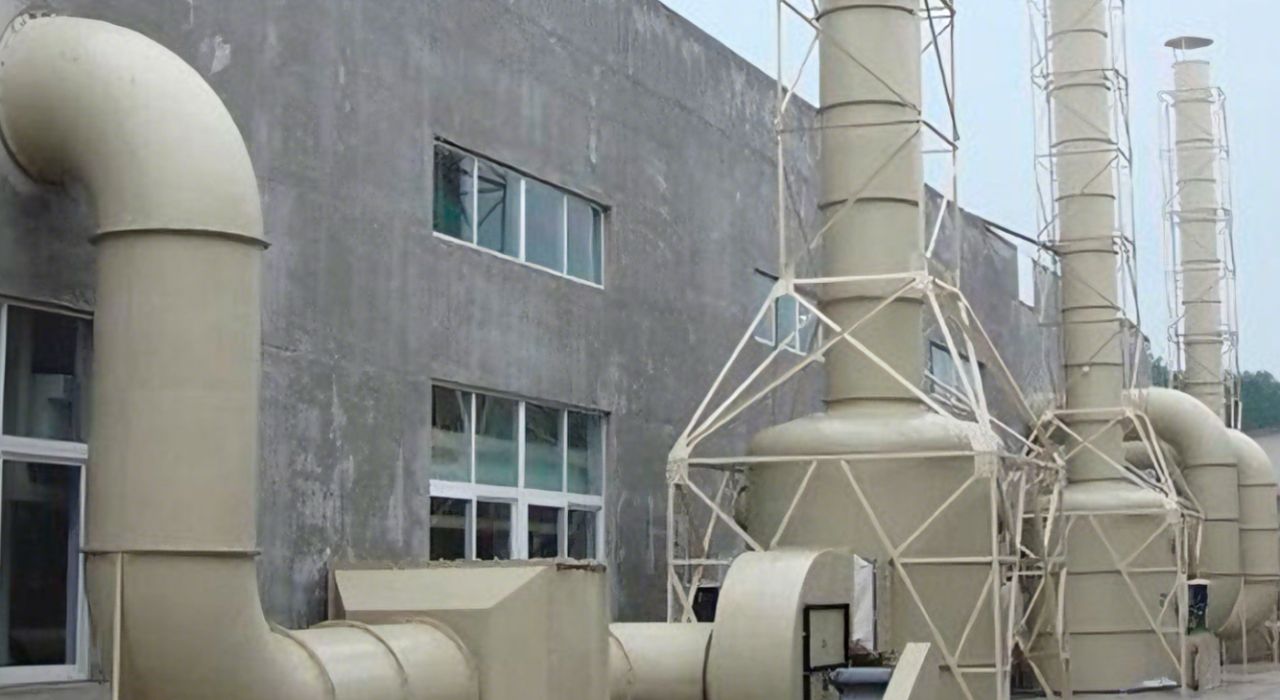
An FRP Scrubber Tower is a broader category of gas cleaning equipment that uses liquid spraying, turbulence, and sometimes packing to remove pollutants from industrial exhaust streams. Unlike absorption towers, scrubbers are designed for flexible gas treatment conditions rather than specific chemical reactions.
Scrubber systems can handle particulate matter, acidic gases, odors, and mixed pollutants simultaneously. Their internal design may include spray chambers, venturi sections, or hybrid packed zones depending on application requirements.
Because of this flexibility, scrubbers are commonly used in wastewater treatment plants, general industrial ventilation systems, and processes where gas composition fluctuates frequently and precise reaction control is not required.
The working principle of an FRP Absorption Tower is based on gas–liquid counter-current mass transfer combined with chemical equilibrium control. Pollutants are absorbed into a liquid phase through diffusion and reaction mechanisms, making process stability highly dependent on flow uniformity and contact efficiency.
In contrast, an FRP Scrubber Tower relies more on mechanical contact between droplets and gas streams. Pollutants are captured through impact, dissolution, and partial absorption, but the system is less dependent on strict reaction kinetics.
From an engineering perspective, absorption towers require controlled hydrodynamics, while scrubbers prioritize turbulence and adaptability.
This fundamental difference determines how each system behaves under variable operating conditions.
Inside an FRP Absorption Tower, gas flow must be evenly distributed across the cross-sectional area to ensure consistent contact with the packing layer. Uneven flow leads to channeling, where parts of the packing are overused while others remain inactive.
Liquid distribution is equally critical. Spray systems must maintain uniform wetting across the entire bed surface to prevent dry zones, which can significantly reduce mass transfer efficiency.
In an FRP Scrubber Tower, gas flow behavior is less constrained. The system relies on droplet interaction and turbulence, meaning slight flow variations have less impact on overall performance. However, this flexibility comes at the cost of lower reaction precision.
The FRP Absorption Tower uses a diffusion-driven mass transfer mechanism. Pollutants move from gas phase to liquid phase based on concentration gradients and solubility properties. Structured packing enhances this process by increasing surface contact area and reducing diffusion resistance.
In some applications, chemical reactions accelerate absorption efficiency. For example, acidic gases react with alkaline solutions to form stable salts, improving removal efficiency and reducing re-emission risk.
On the other hand, an FRP Scrubber Tower relies more on physical capture mechanisms such as droplet impaction and surface adsorption. While effective for mixed pollutants, it is less efficient for high-purity chemical removal applications.

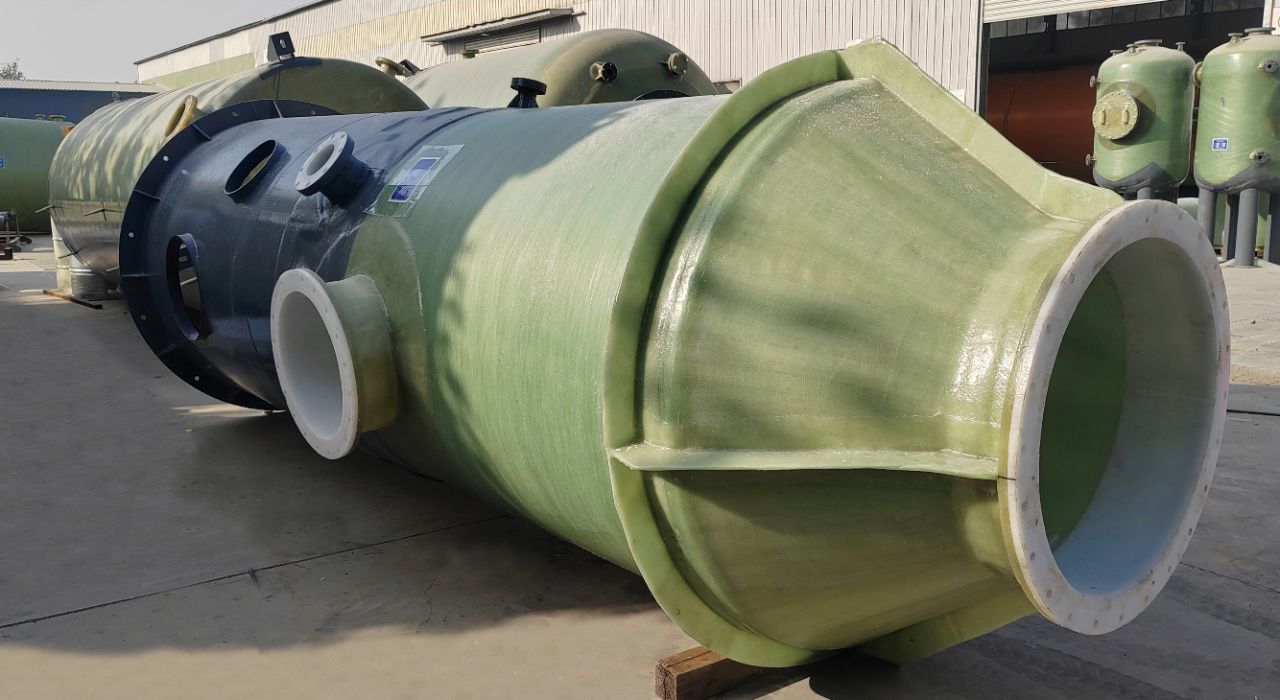
A typical FRP Absorption Tower is composed of multiple integrated subsystems that work together to maintain stable gas–liquid mass transfer conditions inside a corrosive environment. The outer shell is manufactured using FRP corrosion-resistant laminate, which provides structural integrity under continuous exposure to acidic gases and humid operating conditions. Inside the tower, structured packing or random packing is installed to increase effective contact surface area, which directly determines the efficiency of pollutant transfer from gas phase to liquid phase. Above the packing section, a liquid distribution system composed of spray nozzles ensures uniform wetting across the entire cross-section, while at the outlet section, mist eliminators remove entrained droplets to prevent secondary emissions. At the bottom, the gas inlet and circulation system is designed to control flow distribution and maintain stable hydraulic behavior.
In contrast, an FRP Scrubber Tower follows a structurally simpler and more flexible configuration, which is designed for handling variable and mixed industrial exhaust streams rather than controlled chemical reaction environments. A typical scrubber system may include a spray chamber where liquid droplets are introduced directly into the gas stream, sometimes combined with a Venturi section to increase turbulence and particle capture efficiency. Depending on application requirements, a simplified packing section may also be added, followed by a droplet separation system that removes moisture and particulate-laden mist from the outgoing gas flow. Compared with absorption towers, scrubbers prioritize operational adaptability and mechanical simplicity over precise mass transfer control.
From a performance engineering perspective, an FRP Absorption Tower is designed to achieve higher removal efficiency for specific gaseous pollutants by optimizing gas–liquid contact time, interfacial surface area, and reaction stability inside a structured packing environment. Because the system is based on controlled counter-current mass transfer, it performs particularly well in applications where gas composition is stable and emission standards are strict. However, this level of efficiency is highly dependent on stable hydraulic conditions, meaning that deviations such as uneven liquid distribution, nozzle blockage, or packing fouling can quickly lead to measurable performance degradation.
An FRP Scrubber Tower, on the other hand, operates under a more tolerant mechanical and fluid dynamic regime. It can accommodate fluctuations in inlet gas flow, variations in pollutant concentration, and mixed contaminant streams without significant system instability. However, because its design relies more on droplet interaction and turbulent contact rather than optimized mass transfer surfaces, its overall removal efficiency is generally lower when compared to a properly designed absorption system. In practical engineering applications, scrubbers are often selected for robustness and flexibility, while absorption towers are selected for precision and efficiency.
The FRP Absorption Tower is widely used in industrial sectors where gas composition is relatively stable and high-efficiency chemical removal is required over long-term continuous operation. In chemical manufacturing environments, it is commonly applied for acid gas neutralization, hydrogen chloride recovery, and chlorine-related process emissions control. Fertilizer production plants use absorption towers to manage ammonia and sulfur-based gases generated during reaction and drying processes, where process stability is critical. In metallurgical industries, the system is used for flue gas purification under corrosive and high-temperature conditions, while semiconductor and specialty chemical industries rely on it for high-purity exhaust treatment where contamination control and emission precision are essential.
The FRP Scrubber Tower is typically applied in environments where gas composition is variable, pollutant types are mixed, or emission characteristics change dynamically during operation. Wastewater treatment facilities often use scrubbers for odor control and general exhaust neutralization, where strict chemical selectivity is not required. General industrial ventilation systems also rely on scrubber technology to handle mixed air pollutants in manufacturing environments. In multi-pollutant emission scenarios, scrubbers provide a practical solution due to their ability to maintain stable operation under fluctuating process conditions, even if the removal efficiency is lower than that of absorption-based systems.
Selecting between an FRP Absorption Tower and an FRP Scrubber Tower requires a process engineering evaluation rather than a simple comparison of equipment specifications or dimensions. The first key factor is gas composition stability, since absorption systems require relatively stable inlet conditions to maintain predictable mass transfer performance, while scrubbers are more tolerant of variability. Pollutant concentration levels also play a critical role, as high-efficiency removal requirements generally favor absorption systems. Additional parameters such as temperature, humidity, energy consumption, and long-term operating cost must also be considered because they directly affect lifecycle performance and system economics.
In engineering practice, selection is ultimately determined by process requirements rather than equipment preference. High-precision emission control systems typically require absorption technology, while flexible multi-condition environments are better served by scrubber systems. This makes the decision a system-level design choice rather than a procurement decision.
Long-term operation of an FRP Absorption Tower depends heavily on maintaining stable hydraulic conditions and consistent chemical performance inside the system. Liquid distribution uniformity is particularly important, as even minor nozzle blockage or pressure imbalance can significantly affect wetting efficiency across the packing bed. Although FRP materials provide excellent corrosion resistance, internal components such as pumps, spray systems, and packing materials still require periodic inspection due to mechanical wear, scaling, and particulate accumulation.
Pressure drop monitoring is one of the most reliable indicators of system health in both absorption and scrubber systems. Gradual increases typically indicate fouling or partial blockage within the internal structure, while sudden fluctuations may suggest flow redistribution or hydraulic instability. In industrial operation, system performance is better evaluated over long time cycles rather than short-term operating snapshots, since stability is the key indicator of reliable gas treatment performance.
The fundamental difference between an FRP Scrubber Tower and an FRP Absorption Tower lies not only in their structural configuration but also in their engineering philosophy and intended process control level. Absorption towers are designed for controlled chemical reaction systems with high efficiency and stable emission requirements, while scrubber towers are designed for operational flexibility and mixed pollutant handling in variable environments.
In modern industrial gas treatment design, neither system can be considered universally superior. Their performance is entirely dependent on process conditions, emission requirements, and long-term operational strategy. A correct selection ensures stable compliance, optimized lifecycle cost, and reliable industrial performance under real operating conditions.