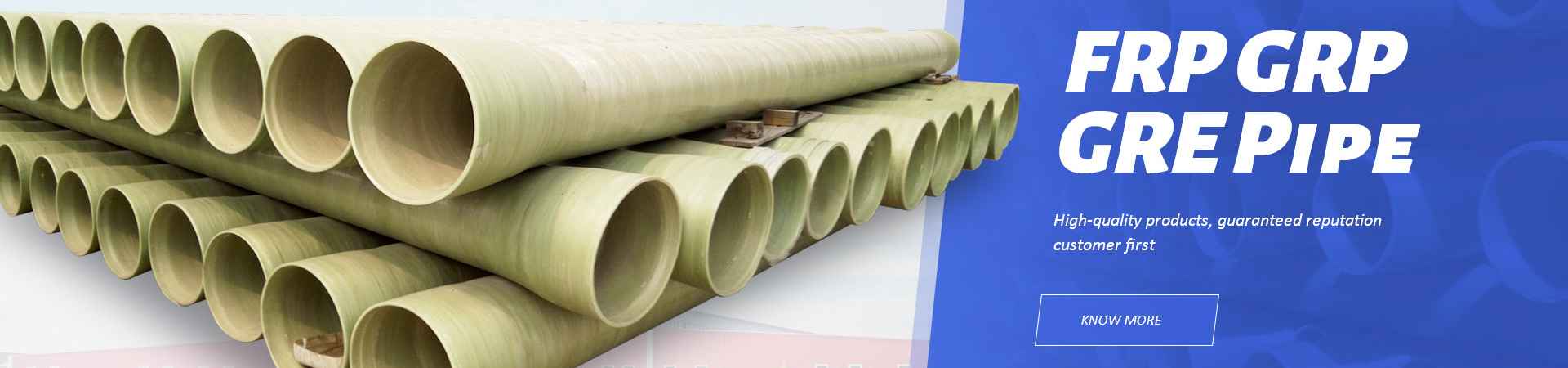

Fiberglass reinforced plastic (FRP) pipes are becoming increasingly popular across many industries. From municipal water systems to chemical plants, these pipes provide an excellent combination of strength, corrosion resistance, and long service life.
But how are these pipes actually made?
Understanding the FRP pipe manufacturing process helps engineers, project managers, and manufacturers better appreciate why FRP pipes are such a reliable solution. In this guide, we’ll walk through each stage of production in simple terms—from raw materials to finished pipes ready for installation.
Whether you’re researching composite pipe technology or planning to invest in a production line, this article will give you a clear overview of the entire process.
Before we dive into the FRP pipe manufacturing process, it’s helpful to understand what an FRP pipe actually is.
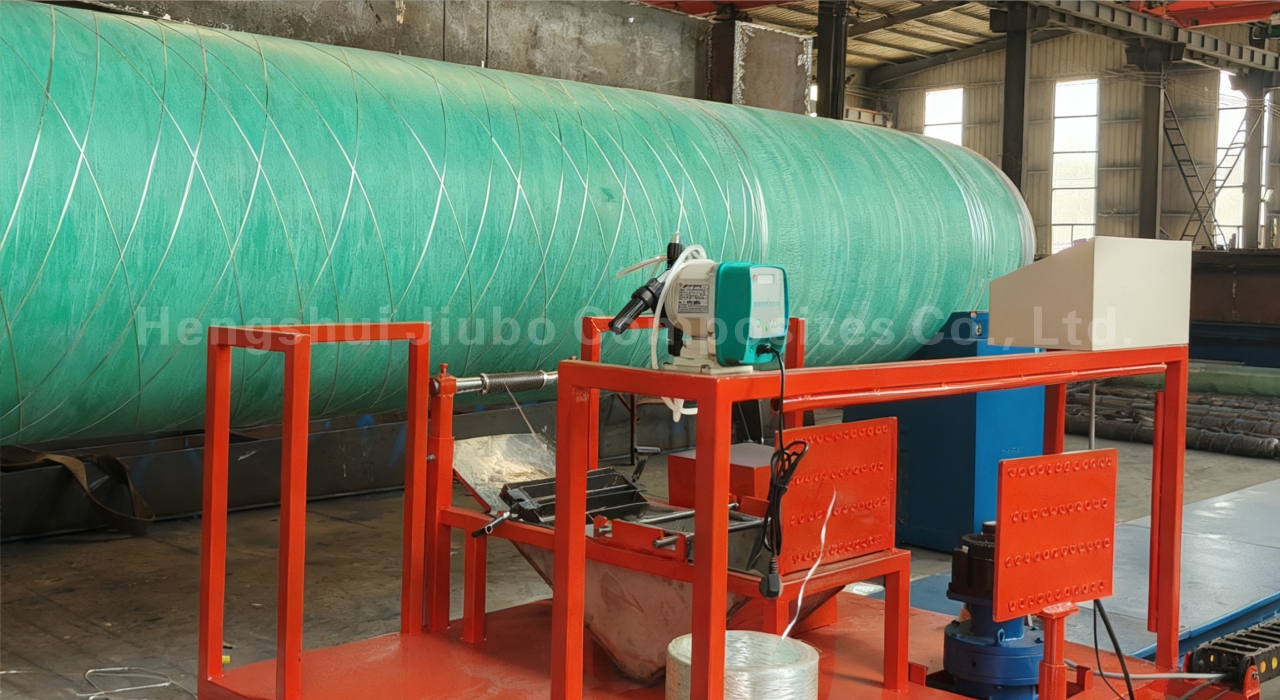
FRP stands for Fiberglass Reinforced Plastic, which is a composite material made from:
Fiberglass reinforcement
Thermosetting resin
Fillers and additives
Fiberglass provides mechanical strength, while the resin binds the fibers together and protects them from environmental damage. This combination results in a pipe that is strong, lightweight, and resistant to corrosion.
Because of these advantages, FRP pipes are widely used in:
Water supply systems
Wastewater treatment plants
Chemical processing facilities
Industrial pipelines
Agricultural irrigation systems
Now let’s explore how these pipes are produced.
The first stage in the FRP pipe manufacturing process is preparing the raw materials.
Fiberglass roving is the main reinforcement material. These long strands of glass fibers provide tensile strength and structural support.
The fibers are typically supplied in large spools that feed directly into the production machine.
The resin acts as the matrix that holds the fibers together. Common resin types include:
Polyester resin
Vinyl ester resin
Epoxy resin
Each type of resin offers different performance characteristics. For example, vinyl ester resins provide excellent chemical resistance.
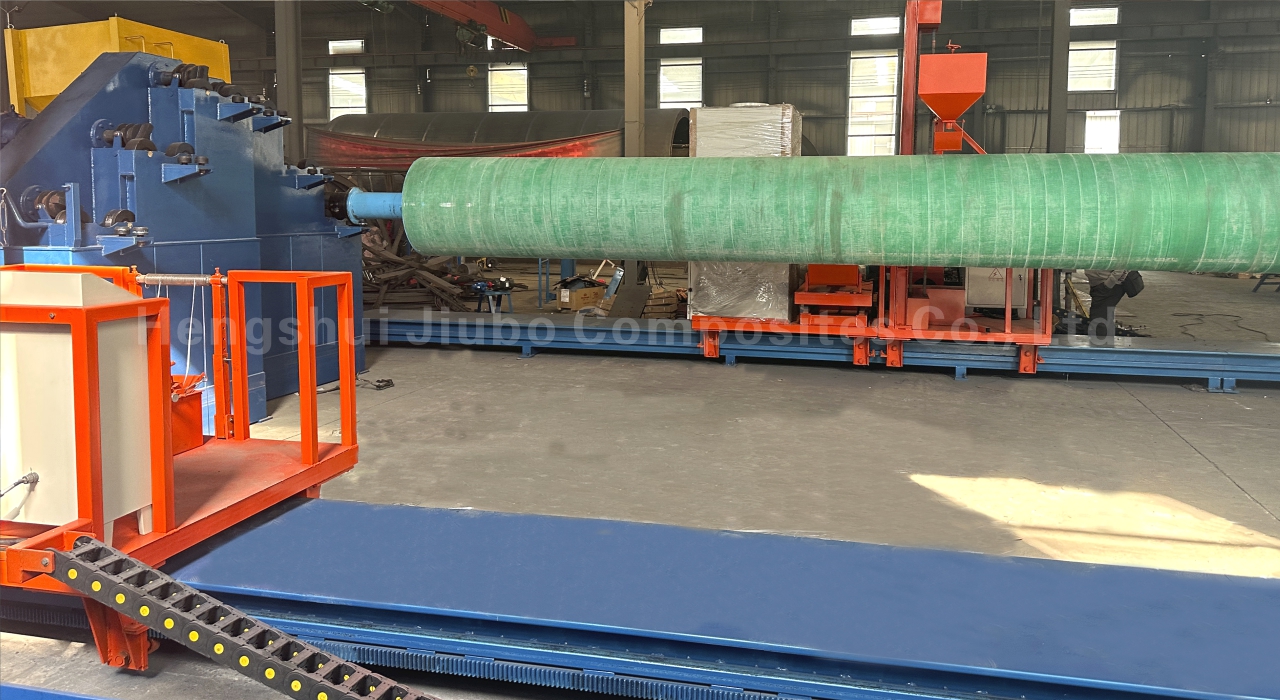
Quartz sand or calcium carbonate may be used as fillers. These materials help improve stiffness and reduce production costs.
Once all materials are prepared, the production line can begin operating.
A mandrel is essentially the mold used to shape the pipe.
During the FRP pipe manufacturing process, fiberglass layers are wound around the mandrel to form the pipe wall.
Before production begins, the mandrel is cleaned and coated with a release agent. This prevents the finished pipe from sticking to the mold and allows it to be removed easily after curing.
Mandrels can vary in size depending on the pipe diameter being produced.
For fiberglass pipes to achieve high strength, the fibers must be thoroughly coated with resin.
This stage of the FRP pipe manufacturing process involves passing the fiberglass fibers through a resin bath.
Inside the bath, fibers become fully saturated with resin, ensuring:
Proper bonding between fibers
Consistent structural performance
Strong resistance to moisture and chemicals
If resin distribution is uneven, the pipe may develop weak areas, which is why this stage is carefully controlled.
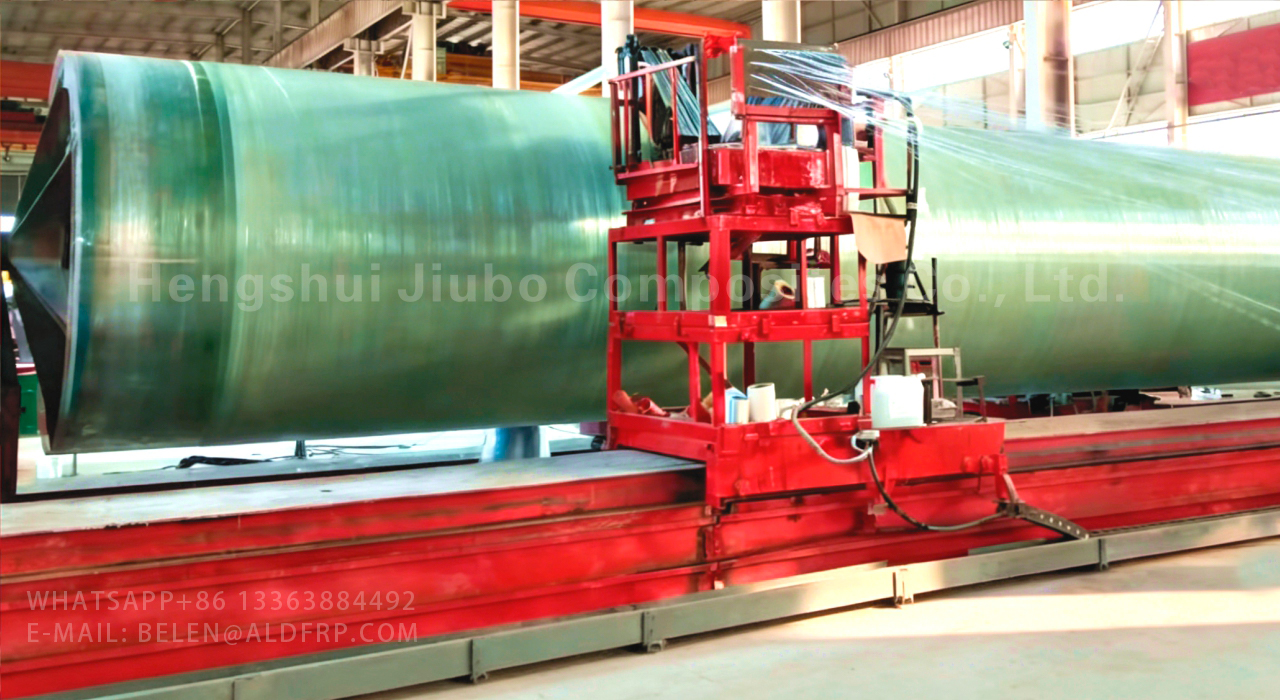
The filament winding stage is the core of the FRP pipe manufacturing process.
During this step, resin-impregnated fiberglass fibers are wound around the rotating mandrel using a specialized machine.
The machine controls several key parameters, including:
Winding angle
Fiber tension
Rotation speed
Layer thickness
Different winding patterns are used depending on the pipe’s performance requirements.
Hoop winding places fibers around the pipe in a circular pattern. This greatly improves resistance to internal pressure.
Helical winding applies fibers diagonally along the pipe, improving axial strength and flexibility.
By combining these patterns, manufacturers can produce pipes that are both strong and durable.
In many large-diameter pipes, a sand layer is added between fiberglass layers.
This step in the FRP pipe manufacturing process helps improve structural stiffness while reducing material costs.
The sand is usually mixed with resin and applied while the pipe is rotating.
This layer does not reduce pipe strength—in fact, it often improves performance by increasing rigidity.
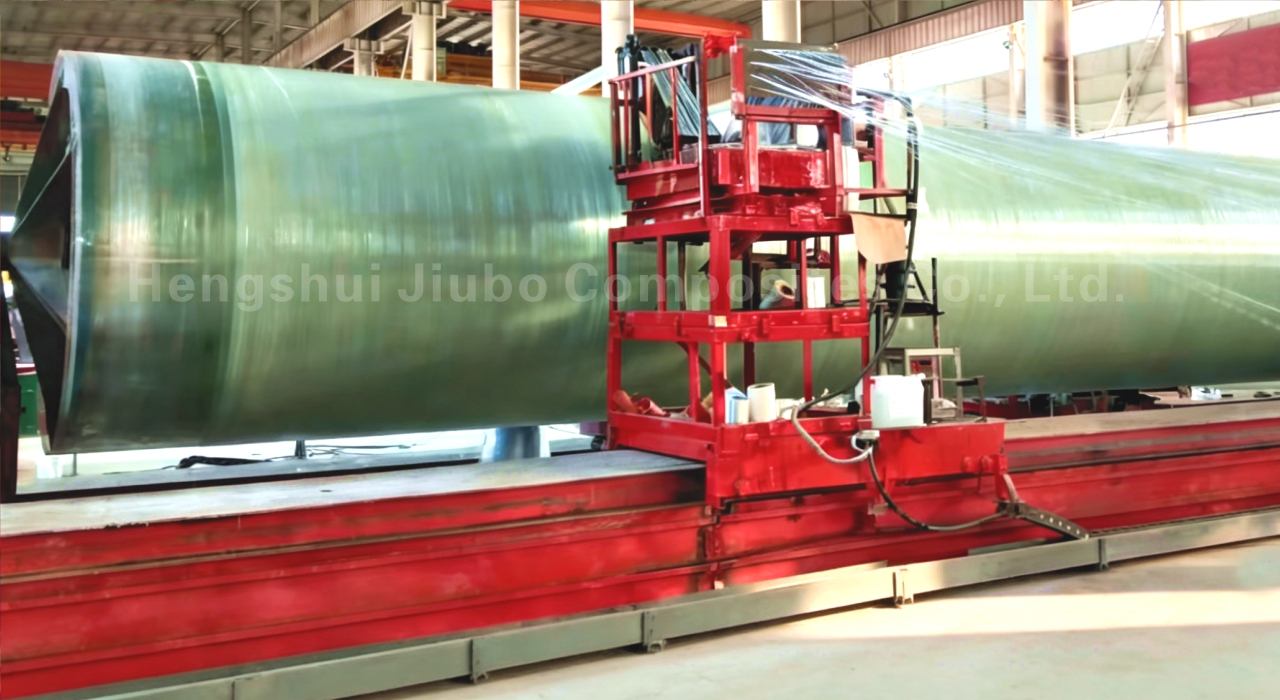
The pipe wall is created by repeatedly applying fiberglass and resin layers.
Each layer contributes to:
Wall thickness
Structural strength
Pressure resistance
The exact number of layers depends on the pipe design and application.
Modern manufacturing machines can precisely control layer thickness, ensuring consistent pipe quality.
Once the winding process is complete, the pipe must be cured.
Curing is the stage where the resin hardens and bonds the fiberglass fibers together. This transforms the pipe from a flexible structure into a rigid composite material.
Curing methods in the FRP pipe manufacturing process may include:
Natural curing at room temperature
Oven curing with controlled heat
Infrared heating systems
Proper curing ensures the pipe reaches its full mechanical strength.
After curing, the finished pipe must be removed from the mandrel.
This stage of the FRP pipe manufacturing process is called demolding.
Special equipment may be used to slide the pipe off the mandrel smoothly without damaging its structure.
Once removed, the pipe moves to the finishing stage.
At this stage, the pipe is trimmed and prepared for final use.
Typical finishing operations include:
Cutting pipe ends to the required length
Surface smoothing or polishing
Adding connection joints or grooves
These steps ensure the pipe meets project specifications.
Quality control is the final step in the FRP pipe manufacturing process.
Every pipe must pass strict testing before leaving the factory.
Common tests include:
Hydrostatic pressure testing
Wall thickness measurement
Visual inspection
Dimensional verification
These tests confirm that the pipes meet industry standards and project requirements.
The FRP pipe manufacturing process offers several advantages over traditional pipe production methods.
FRP pipes are highly resistant to chemicals, moisture, and saltwater.
Compared with steel or concrete pipes, FRP pipes are much lighter and easier to transport.
FRP pipes can last 30–50 years or more with minimal maintenance.
Manufacturers can adjust diameter, wall thickness, and resin type to meet different project needs.
Thanks to the advanced FRP pipe manufacturing process, these pipes are used in many industries, including:
Municipal water systems
Wastewater treatment plants
Chemical pipelines
Industrial cooling systems
Agricultural irrigation networks
Their durability and corrosion resistance make them ideal for demanding environments.
The demand for composite pipes is growing rapidly worldwide. Infrastructure projects, environmental regulations, and industrial expansion are driving the need for durable pipeline solutions.
As manufacturing technology continues to improve, the FRP pipe manufacturing process is becoming more automated, efficient, and precise.
This means FRP pipes will likely play an even larger role in future infrastructure projects.
The FRP pipe manufacturing process combines advanced materials with modern engineering techniques to produce pipes that are strong, lightweight, and resistant to corrosion.
From raw material preparation to filament winding, curing, and final inspection, every step is carefully designed to ensure high product quality.
For industries that require reliable and long-lasting pipelines, FRP pipes provide an efficient and cost-effective solution.